The History of Calabasas: The Leonis Adobe, Hidden Hills, Lake Sherwood and the Conejo Valley
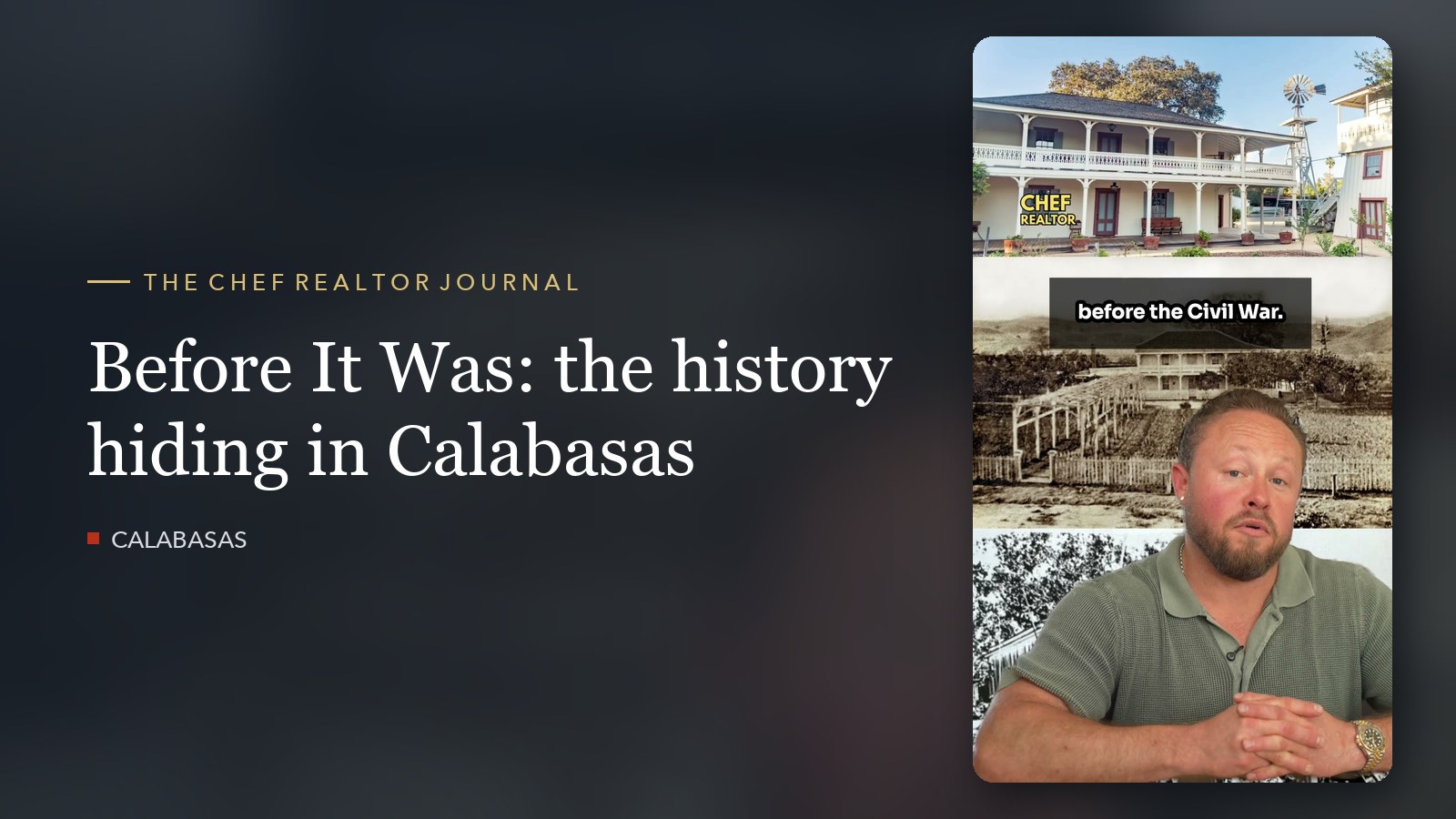
The history of Calabasas runs from Chumash villages to Spanish expeditions, a mission-era road, an 1844 adobe and a city that only incorporated in 1991. Most of it is still standing if you know where to look. This is my "Before It Was" guide to Calabasas, Hidden Hills, Westlake Village and the Conejo Valley, with every fact checked.
I grew up here and I didn't know half of this until I started digging. Good history is like a good stock: it takes time, and the best part is what's been simmering underneath.
Calabasas before it was a city
The Chumash lived in these hills for centuries before Europeans arrived. A Portolá expedition passed through in 1770, and a de Anza party camped here in 1776, according to the Calabasas Chamber of Commerce.
The earliest surviving written mention of Calabasas as a place is a San Fernando Mission document dated August 19, 1795. Calabasas Road itself was part of El Camino Real, the route linking California's missions.
Where the name came from is still a debate. The popular story ties it to calabaza, Spanish for pumpkin or gourd. Another traces it to a Native American word said to mean "where the wild geese fly." Take your pick. I've always liked the pumpkin one.
The Chamber says Park Moderne, from the 1920s, was the first planned subdivision, settled by artists, craftsmen and writers. Calabasas stayed rural well into the 20th century. People came for horses and quiet, close to LA but far from the chaos. The city incorporated on April 5, 1991.
The Leonis Adobe
The oldest part of the Leonis Adobe at 23537 Calabasas Road dates to 1844, six years before California statehood. Miguel Leonis, the "King of Calabasas," acquired it in the 1850s or 1860s and enlarged it by the 1870s, per its Wikipedia history.
His Chumash wife, Espiritu, sued for her share of the estate after his death in 1889. A jury awarded her half in 1891, and the legal fight dragged on until 1905.
In 1961 the owner applied to raze the adobe for a supermarket. Preservationists saved it, at a cost of about $240,000, and in August 1962 it became Los Angeles Historic-Cultural Monument No. 1. It opened as a museum in 1966. Today it's a working 1880s ranch with cattle, goats and chickens.
King Gillette Ranch
The Spanish Colonial Revival mansion and buildings at King Gillette Ranch were designed in the 1920s by Wallace Neff for razor magnate King C. Gillette, per the National Park Service. Today it's 588 acres of public parkland at 26800 Mulholland Highway, and the site of the December 2 wildlife crossing dedication, per the Acorn.
Hidden Hills: $4,750 an acre
My childhood home is in Hidden Hills, so this one's personal. Developer A.E. Hanson, who also built Rolling Hills on the Palos Verdes peninsula, started Hidden Hills in 1950, per the City of Hidden Hills.
The advertised price that year for a full acre lot: $4,750. By 1957, three or four bedroom homes on one acre sold for $27,500 to $47,500.
The horse culture was there from the start. A "Church on Horseback" began in 1959, and the first Fiesta in 1962 included a horse show. Voters approved cityhood on September 19, 1961, and Hidden Hills became the county's 73rd city on October 19, 1961.
Westlake, Lake Sherwood and the Conejo Valley
Westlake Village
In 1881 the Russell brothers bought the land for cattle ranching at about $2.50 an acre. Historian Patricia Allen says Andrew Russell sealed the deal with a $20 gold piece, per Wikipedia's history of Westlake Village.
In 1963, Daniel K. Ludwig's American-Hawaiian Steamship Company bought the 12,000-acre ranch for $32 million. With Prudential, it hired A.C. Martin and Associates for a master plan: a "city in the country" built around a man-made lake.
The county line still splits the community. The Los Angeles County side incorporated as the City of Westlake Village on December 11, 1981. The Ventura County side was annexed into Thousand Oaks. The lake itself was drained in 1983 to 1984.
Lake Sherwood
Rancher W.H. Matthiessen finished a dam in 1904, creating the 165-acre Potrero Lake, per Wikipedia's Sherwood Dam history. It is still one of the oldest standing dams in California.
In 1921 his son let Douglas Fairbanks shoot Robin Hood around the lake. The film came out in 1922, and the place has been Sherwood ever since.
The rest of the valley
- Agoura Hills: Paramount Pictures leased Paramount Ranch in 1927, per the National Park Service. It hosted more than 130 productions, earned the nickname "Picture City," and held the Renaissance Pleasure Faire from 1966 to 1989.
- Malibou Lake: scenes from Frankenstein (1931) were filmed there.
- Thousand Oaks: the Goebel lion farm stood where the Civic Arts Plaza is now.
- Newbury Park: Egbert Newbury ran the first post office out of a tent starting July 16, 1875, and the Stagecoach Inn was built in 1876.
Over the hill: Casa Vega turns 70
One Valley bonus. Ray Vega opened Casa Vega in 1956, at 22, the first sit-down Mexican restaurant on Ventura Boulevard, CBS Los Angeles reported. His parents had opened Café Caliente on Olvera Street in 1936, per LA Weekly.
On May 5, 2026, the corner of Ventura and Fulton was renamed "Vega Square." The 70th year also brought the new 3,000 square foot Ray Vega Patio. It won a James Beard America's Classics award in 2022.
Living here now? The real pros and cons of Calabasas picks up where the history leaves off.
Then vs. now: what homes sell for today
Hidden Hills homes sold for $27,500 to $47,500 in 1957. And in October 1981, two months before Westlake Village incorporated, the Freddie Mac 30-year mortgage rate hit 18.63%. Here is today.
- Hidden Hills: median sale about $5.8 million, about 54 days on market.
- Calabasas 91302: median sale about $2.01 million, about 37 days.
- Westlake Village 91361: median sale about $1.8 million, about 36 days.
- Lake Sherwood: median sale about $2.3 million, about 40 days.
Source: The MLS, single-family homes sold in the 12 months ending October 7, 2026.
Own one of these? See the Hidden Hills and Calabasas home value pages.
Or call or text me at 818-297-8667. I'll pull the sales that actually compare to yours.